Re-reading Caetano's book from my Bahian hammock
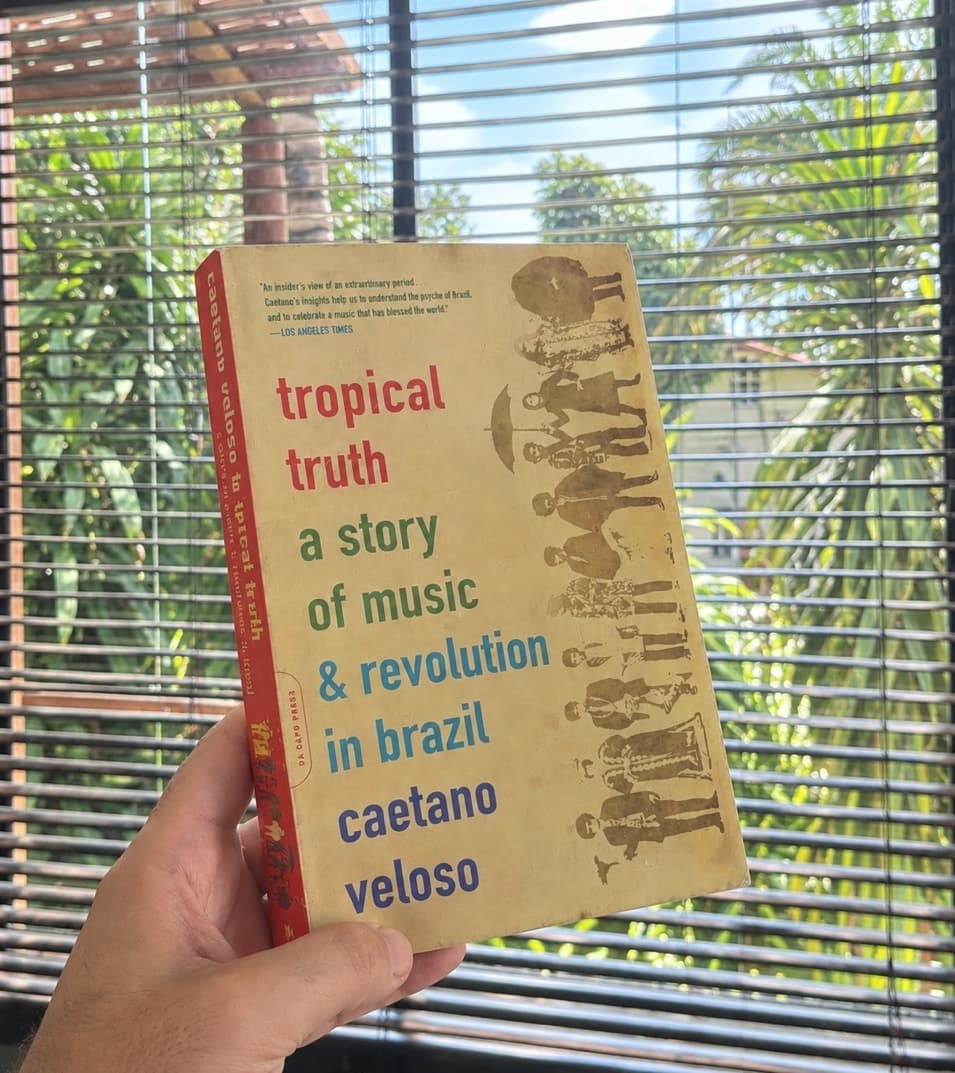
I just came back from a month in a small village on the southern coast of Bahia, Brazil. This region holds a special place in the heart of any Brazilian music lover, and it's tied to my own musical journey. My first band, in Spain in the mid-2000s, played mostly songs by Bahian composers. And Salvador is the city I landed in on my first trip to Brazil, back in 2008. Since then I have worked with several Bahian musicians, like Josyara, Lucas Santtana and Giovani Cidreira, and I produced my friend Luizga's Bahia-fuelled song "Yemamaya".
The village I stayed in is right next to the beach where Luizga filmed the music video for "Yemamaya". It's a quiet, remote place, and I spent most of my time writing music, surfing and reading. I had brought one of my all-time favourite books: "Verdade Tropical", a long memoir and essay by Bahia's own Caetano Veloso, one of Brazil's music giants and a sharp intellectual.
I first came across Caetano outside of Brazil, on a Parisian cinema screen, in Pedro Almodóvar's "Hable con ella" (2002), singing "Cucurrucucú paloma". His performance opened an emotional door and made me curious about Brazilian music. Shortly after, an Argentine friend lent me his album "Joia" on CD. I had no clue what the lyrics meant, but the music had the right balance: comforting and challenging, familiar and exotic.
My fascination with his music and lyrics grew as I learned Portuguese and explored the breadth of his discography. I first read his memoir when I was living in Lisbon. I was blown away. Here was a pop star who could move from Marcel Proust to James Brown, and who treated thinking about music as part of making it. That was exactly how I wanted to work: researching, reading, mixing genres without asking permission.
"Tropical Truth" is centred on the history of Tropicalismo, the cultural movement he started with other artists in the late 60s. It emerged in the early years of the dictatorship, in a polarised cultural scene. On one side stood those eager to defend Brazil's musical heritage against American cultural dominance. This camp, led by musicians such as Elis Regina, went as far as organising a march against Brazilian rock and pop.
On the other side of this mid-60s schism stood Roberto Carlos, Erasmo Carlos and the Jovem Guarda movement. Their sound, lyrics and look borrowed from American culture. At least, that's how the nationalists perceived them. Caetano already heard something deeply Brazilian in their music.
Caetano, Gilberto Gil and the other Tropicalistas set out to continue what their idol João Gilberto had started: absorbing the new without losing the Brazilian thread. Refusing the terms of the debate, they drank from the Beatles and Jimi Hendrix the way João had drunk from cool jazz. They kept honouring and recycling their Bahian and Northeastern roots, while teaming up with some of the most avant-garde poets and composers in São Paulo.
The breadth of the Tropicalistas' approach, and their courage to swim against the current, had a deep influence on my own music: the use of current technology and urban trends, the pull of timeless regional and spiritual music, the admiration for poets and writers, the openness to pop and kitsch nostalgia. The book also shows how much literature and Caetano's own music nerdiness shaped his art.
I couldn't be more jealous of the intellectual and artistic community Caetano describes. He always seems to be surrounded by eccentric, out-of-the-box artists and thinkers. The community spirit of Brazilians and the rich, diverse art scenes of Salvador, São Paulo and Rio de Janeiro are protagonists of the book in their own right. Within this galaxy of writers, film directors, avant-garde musicians and visual artists, Caetano also built lifelong collaborations with Gilberto Gil, Maria Bethânia and Gal Costa. Gal passed away a few years ago, but the other three are still making music together, more than 60 years later.
In music as in politics, he has always refused black-and-white thinking, including within his own political camp. This resonates with me in a polarised world, shaped by the intellectual alienation of social media. Purism is more alive than ever, in art and in politics.
I'm writing this as Lula wins the presidential election against Flávio Bolsonaro, against all odds. A relief, but a fragile one. Caetano, who was jailed and exiled by the dictatorship, knows that barbaric politics is never far away. That's why his voice still matters. In his 80s, he is still touring, still taking part in the political debate, still writing songs and releasing albums.
Long live Caetano.